By Patrick Gordon, technical manager, Splashworks
As we face winter, we are once again facing freezing conditions. This brings up the often-asked question, “What can I do to protect my plumbing pipes from bursting when the temperatures are freezing?”

-
- All images and technical drawings supplied by Caleffi
Lagging the pipes is often not enough, and we need to go that one step further.
There is a nifty product called an anti-freeze valve that will help protect the pipes and fittings from the effects of freezing conditions. It does not prevent freezing, but it does remove the threat of having the pipes burst.
So how does it work?
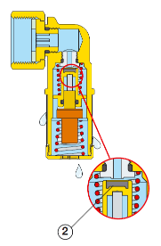
A thermostatic element (1) in contact with the ambient air controls a shut-off spindle fitted to a passage seat in contact with the water contained in the pipe (2). When the ambient temperature drops to the minimum intervention value (3°C), the thermostat contracts. This causes the shut-off spindle to move and open a tiny passage so that water can drain out, allowing a small amount of water to flow continuously; this prevents water from freezing inside the pipe.
Water from the supply network, which is usually warmer than the air temperature up to the intervention value (4°C), flows over the thermostat and causes the opposite action: the channel closes again and normal circuit operating conditions are restored.
For optimal system operation without the risk of freezing, it is recommended that the part of the circuit in which the safety device is installed is not connected to a dead leg but to the water supply network and a suitable pressure level is maintained. The ideal placement of the valve is on a pipeline where the ambient temperature gets the coldest – normally where the pipes have frozen before.
While the anti-freeze device is in operation, the drain outlet will drip because of the cyclical opening and closing phases taking place correctly. The amount of water drained out varies in accordance with the outdoor temperature, the temperature of the water in the pipe and the length of piping exposed to the air. As a general guide, in the worst-case conditions, the amount of water drained out is less than 500mℓ.
It is advisable to have a tundish below the valve to channel the discharge water to an area where it will not be a nuisance, but where the discharge is still visible.
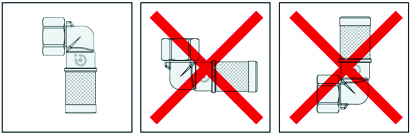
Before installing the device, make sure that the system has been flushed and cleaned to remove any traces of dirt that may have accumulated during installation. The device must only be installed in a vertical position, as shown in the diagram, to permit a free and unrestricted downward flow of the water as it drains out – this ensures that the water flowing passes over the thermal probe to allow the valve to close again.