By Kurt Vermaak of Zero2One Plumbing
In this article, Kurt Vermaak breaks down the role of the plumber when it comes to limescale, what every property owner should know about limescale, as well as how to prevent limescale formation through the different solutions available on the market. This is part two of a two-part series.

Limescale build up is costly in the long run.
All images supplied by Kurt Vermaak
The role of the plumber when it comes to limescale
Plumbing professionals play a vital role in helping homeowners, facility managers and business owners identify, prevent and manage the damaging effects of limescale. Their expertise allows them to detect problems early, recommend appropriate solutions, and implement preventative measures that protect plumbing systems and water-heating equipment.
Homeowners and limescale build-up
Many property owners view limescale as a minor maintenance issue, but the financial impact can be substantial. Because limescale develops slowly, its costs are often hidden in higher utility bills, increased maintenance expenses, equipment failures and premature replacement of infrastructure
By preventing scale buildup, property owners can:
- Protect their plumbing infrastructure
- Improve energy efficiency
- Reduce maintenance and repair costs
- Extend the lifespan of equipment
- Maintain water flow and pressure
- Avoid unexpected breakdowns
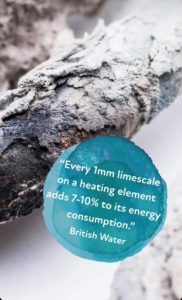
Every 1mm of limescale on a heating element adds 7–10%to its energy consumption – British Water.
Preventative measures to reduce limescale formation
While limescale cannot always be eliminated entirely in hard-water areas, there are several effective strategies that can significantly reduce its formation, protect equipment, and lower maintenance costs. One of the most effective preventative measures is to treat or condition water before it enters the plumbing system. Solutions such as Halcyan Water Conditioners, along with other scale-management technologies, can help reduce the formation and adhesion of limescale, protecting pipes, geysers, boilers, valves and water-using appliances throughout the property.
Several technologies are available to help manage hard water and reduce the effects of limescale:
- Halcyan Water Conditioners – A non-chemical water-conditioning technology designed to help reduce limescale buildup while retaining naturally occurring minerals in the water.
- Salt-based water softeners – Remove hardness minerals such as calcium and magnesium from the water through an ion-exchange process.
- Electronic water conditioners – Use electrical signals to influence the behaviour of hardness minerals in the water.
- Magnetic or catalytic scale-control systems – Utilise magnetic fields or catalytic media to alter the way mineral crystals form, helping to reduce scale adhesion.