By Chris Coetzee
Plumbers often ask, “Why do we need safety on this site?” Generally, I get this question when I am at a residential building doing inspections and ask for their safety documentation. In fact, many go on to say, “This is not a construction site. Safety is not needed here.”

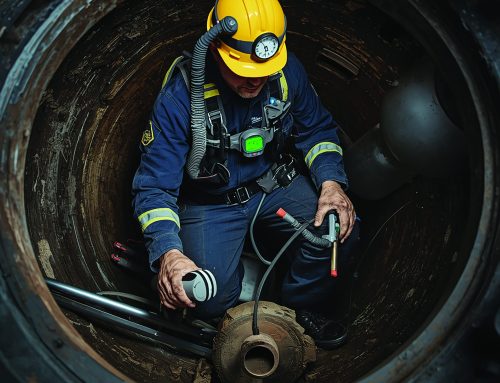
Safety is vital at all sites – from construction to residential. Image by Microsoft Stock Images
What do you think – does it really matter where you are or what scope of plumbing you are doing that determines whether safety is relevant or necessary? Let us look at a few scenarios and then you can make the decision for yourself.
We will start with a particular scope of plumbing in a residential setting and then add in what is necessary from a safety aspect on a construction site for the same scope of work. You can then conclude if the residential plumbing needs less, the same or more safety.
| A client calls you out to install a new geyser – they state the old one is not working and would prefer a new one. The geyser is located in the ceiling, but they have never been up there, so they do not know what to expect. We have discussed hazards in ceilings before with the main hazard being working at a height and the risk of falling to a lower level. |
For construction sites, the requirement would be to ensure safe access to heights where work would be carried out, and there are procedures in place for this specific work area. We know that not every ceiling is the same. There is also a need to ensure your staff are both competent to work at heights and fit to perform the work. Within these requirements are very specific regulations and documents that will be needed, but let’s look again at the goal of what the regulations are trying to achieve. Firstly, it sets a standard that any work at height must be planned so that it can be determined if the work is necessary, and if there can be a limit on how much time is spent in this dangerous situation. It then goes on to regulate who is allowed to work at heights, what the proper procedure is to follow, and outlines the correct fall prevention or protection measures, along with emergency rescue procedures in case of an emergency.
From these requirements, we could now ask the question: “Do you see the need for safety when working inside of a ceiling? How would you safely access the ceiling so as not to fall to the floor? How would you protect yourself from the hazards within the ceiling?”
Clearly, we can take a note from the regulations and have proper planning done and then create a procedure that allows us to consider the before, during and after actions of all work at heights.
Now ask yourself this question: what if something goes wrong – as it has on many occasions as we read in news articles – and someone gets hurt? How would you prove that you did everything in your power to protect yourself or your employees, and further to this, how did you protect the people near you – whether it be the householder or someone else?
Let us drive the point home with a scenario that I had the pleasure of being an eye witness to. A client asked for a leak to be inspected in their private yard – the services ran through the driveway, so the paving needed to be lifted, and the ground excavated to check the piping. After digging down, the excavation eventually started to go lower than 1.5m.
At this point you are saying to yourself, “Well, this is now falling into construction-type work, so safety is needed”.
On a construction site, the depth of excavation is often a set scenario, as all work below 1.5m has specific requirements. Much like working at heights above ground, even the excavation becomes a fall risk, and thus working at height requirements are then implemented as a protection. But on construction sites the teams are led by safety professionals who take into consideration the area around the excavated ground, the work to be performed, and the potential hazards created by the work – not just the depth of excavated ground. Therefore, it may be that even a 1m excavation is treated just as seriously as one that meets the 1.5m requirements.

Have instilled in your employees the safety mindset that stops unsafe work?” Freepik.com
Coming back to the plumbing company in our second scenario, you may think that they would now need to re-evaluate the work since more time and money would need to be spent. However, even prior to the understanding that the excavation would be deeper than 1.5m, the plumbers on this particular job had developed a small file with all necessary requirements for the job – and one of the risks identified was the ‘potential’ for the excavation to go deeper than anticipated. The work done was shown to the client and the file was discussed, and since the client had received the file beforehand, they had to agree to pay extra for the excavator truck, excavation team and bracing to be installed so that all plumbers working would be safe during the excavation. What should we learn from this?
This plumbing company had all safety requirements in place, even though it was not a construction site, and they communicated this with the team and their client which led to this outcome – one I am sure you will appreciate.
The employees stopped working as soon as they realised it would be dangerous and extra precautions were needed. The client accepted the file issued at the start of the project and had to agree that the potential for further excavation and costs may be needed. This resulted in everyone being informed of safety measures prior to any issues occurring, and all were protected from harm and the difficult discussion of extra costs with the client.
Now you may think that you could just put this wording in your quote and state that if changes are required, the client agrees to a requoting process which may protect you from a difficult discussion about extra costs. But would you have instilled in your employees the safety mindset that stopped the unsafe work, created the situation that led to being safe, and have the clients support? This is only achieved by having a safety procedure at the start of the project – no matter where work is going to take place, even if it’s at your own home.
The work area plays a pivotal role in what health and safety requirements we implement, but more important is our behaviour toward health and safety. Are you the type of plumber that is always prepared, regardless of the size of project or task you perform, or are you a reactive plumber who will only take safety seriously after a disaster has occurred?