Today’s plumbing professionals operate in fast-paced environments, where precision, efficiency and reliability are non-negotiables.
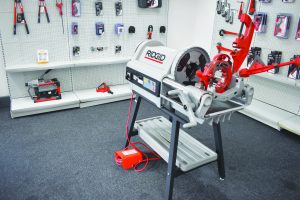
A pipe threading machine, by RIDGID Tools. © Plumbing Africa
In a trade where time truly is money, the right power tool can make all the difference.
In this feature article, we delve into power tools that are beneficial to plumbers, as well as the importance of machine care, the advantages of power tools and the hiring out of power tools.
Today’s plumbing professionals operate in fast-paced environments, where precision, efficiency and reliability are non-negotiables. In a trade where time truly is money, the right power tool can make all the difference. Here, we explore the spectrum of power tools available to plumbing professionals today, focusing on their applications and the advantages they can offer to plumbers.
Drilling tools
These are tools that are used to create holes in walls, concrete, steel and other materials for pipe routing and installations.
• Standard drills – general drilling into wood, plastic, metal and light masonry.
• Angle drills – compact drills designed for working in tight spaces such as ceiling voids or between wall studs.
• Magnetic base drills – heavy-duty drills with a magnetic base that secures the tool to steel surfaces, allowing accurate drilling in structural steel.
• Core drills – used to drill large-diameter holes in concrete or masonry walls for pipe penetrations.
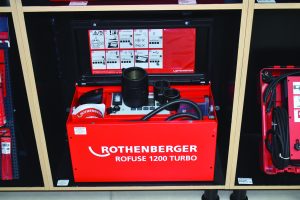
An electrofusion welding machine, by ROTHENBERGER tools.
Demolition and wall preparation tools
Tools used for opening walls, floors, or surfaces during installation or repair work.
• Rotary hammer drills / chipping hammers / impact hammers – used for breaking concrete, removing tiles and chipping channels for pipes.
• Wall chasers – specialised cutting tools that create neat channels in brick or plaster for concealed pipe installations.
Cutting tools
Used for cutting pipes, rods, metal, plastic and construction materials.
• Reciprocating saws – commonly used to cut PVC, copper, steel pipes and threaded rods.
• Electric pipe cutters – motorised cutters designed specifically for fast, clean cutting of pipe materials.
• Threaded rod cutters – designed to cut threaded rod cleanly without damaging the threads.
• Chop saws (cut-off saws) – used to cut metal pipes, rods and structural components.
• Concrete / floor saws – heavy-duty saws used for cutting through concrete floors or slabs for underground plumbing.
• Power cutters – portable high-powered cutting tools often used for masonry, steel or concrete.
Fastening and torque tools
• Impact wrenches – tools used for tightening or loosening bolts and heavy fasteners, often used when installing pipe supports or flanges.
Pipe equipment
Tools used to prepare pipes for joining, welding or mechanical connections.
• Pipe threading machines – used to cut threads into steel pipe for threaded fittings.
• Grooving machines – used to create grooves on pipe ends for mechanical couplings.
• Pipe bevelling machines – used to bevel pipe ends before welding.
• Hydraulic pipe bending machines – used to bend steel pipes without collapsing the pipe walls.
Pipe joining tools
• Pressing tools – used for press-fit pipe connections, instead of soldering or welding.
• Plastic welding equipment
- Butt welding machines – used to fuse HDPE pipes together.
- Electrofusion machines – used with electrofusion fittings that contain heating coils to weld plastic pipes together.
Drain and pipe cleaning equipment
• Drain cleaning machines – motor-driven machines that use rotating cables to clear blocked drains and pipes.
• Pipe cleaning machines – machines used to clean the inside of larger pipes.
Pipe isolation tools
• Pipe freezing machines – used to freeze the contents of a pipe, allowing plumbers to isolate a section without shutting off the entire water system.
This is particularly useful in locations such as hospitals, commercial buildings or shopping centres where water supply interruptions must be avoided.
Benefits of power tools
• Cordless tools create mobility
• Power tools are specialised for specific applications – for example, a wall chaser is specifically designed for chasing, whereas an angle grinder could create more uneven cuts
• Much faster work than with hand tools, allowing you to take on more jobs
• Less physical effort and fatigue, making work easier
• Cleaner, more reliable operations – a power tool can only do what it was designed to do, and there are fewer tools lying around
• If well maintained and regularly serviced, power tools can last for decades before needing to be replaced
• Guaranteed, consistent results
• You look more professional – for example, showing the client on a screen what the inspection camera revealed
• Generally simple to use
• Using power tools gives a better finish than doing the same work manually
Power tools can also help you win more work. Adler Teubes, ROTHENBERGER, says “Last year we gifted leak detection units to plumbers selected by an insurer. Those who used them quickly saw much more work coming in, and some have already invested in additional machinery because of their successes using the tools.”
Looking after your power tools
• Tools come with warranties. Check the warranty when you purchase them, as this will cover any manufacturing defects.
• Service your tools. How often the tools need to be serviced depends on its usage, but you can check with the provider when you purchase it. “Tools will break, so service matters,” says Wayne Klopper, Bosch Tools.
• Use the after-sales services available to you.
• Keep the tools clean.
• Regularly check the tools to ensure everything is in good shape, especially power chords – do not tape up a broken power chord, rather get it professionally repaired.
• Handle your tools with care – don’t just throw them in the back of the van.
• Keep the power tools in safe storage when not in use.
• Always clean your tools after use.
• Ensure you are using the tool correctly – most failures are linked to incorrect use.
Don’t buy cheap
John Marrow, RIDGID, stresses to invest in high-quality, purpose-designed machines because they last longer; while cheaper tools “often have no servicing offerings or spare parts availability, and when they break, you effectively lose the tool and the work time.”
Renting power tools
Power tools can also be rented instead of purchased. Bernard Moore, Talisman, explains that the hiring process involves: an application process, deposit, documentation, vetting, and then collection or delivery.
There are single-day, short-term and long-term rental options available.
While the tool is in your care, you are responsible for it, so insurance is recommended.
Advantages of hiring:
• If a tool breaks down during hire, the company will replace it
• Tools are serviced and inspected before and after hire
• Long-term hires may include servicing or replacement units
© Plumbing Africa