By Megan O’Connor, with technical input from Steyn van Zyl (Steyn’s Plumbing), Patrick Gordon (Splashworks) and Coenie van der Merwe (Standard Hidraulica)
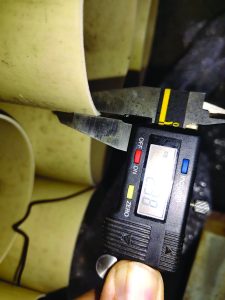
Wall thickness of a 50mm vent pipe. Supplied by Steyn van Zy
In this article, we look at the different types of PVC pipes used in plumbing and their specific applications, as well as their advantages, disadvantages and relevant SANS standards.
PVC pipes are a popular choice in plumbing for water supply, sewer, drainage, stormwater, soil, waste and vent installations. Although PVC pipe is widely available and simple to install, it must never be selected only according to price, colour or diameter. Every pipe installation must be based on the correct SANS standard, pipe class, pressure rating, diameter, wall thickness and the specific purpose for which the pipe will be used.
Types of PVC and their applications
| Type | Name | Main uses |
|---|---|---|
| uPVC / PVC-U | Unplasticised Polyvinyl Chloride | Sewer and wastewater lines |
| PVC-M | Modified Polyvinyl Chloride | Pressure piping |
| PVC-O | Oriented Polyvinyl Chloride | Situations requiring high chemical resistance, such as mining applications |
| CPVC | Chlorinated Polyvinyl Chloride | Hot and cold water piping (has largely been replaced by PEX piping) |
| PP | Polypropylene | Sewer and wastewater lines |
Relevant SANS standards
The SANS standard confirms that the pipe has been manufactured and tested for a specific application and performance requirement. SANS standards provide minimum requirements for the manufacturing, quality and use of plumbing materials and systems.
| Common SANS Standard | Application and examples | Typical use |
|---|---|---|
| SANS 966 (Parts 1 and 2 relate to uPVC and mPVC) | PVC pressure pipe applications, including: • Cold-water supply lines • Pumped water systems • Irrigation systems • Municipal water reticulation • Certain industrial water systems |
Cold-water pressure lines, water supply and reticulation |
| SANS 791 | Sewer and drainpipe applications, including: • Underground sewer lines • Underground drainage lines • Stormwater systems • Inspection chambers • Building drainage connections |
Underground sewer and drainage systems |
| SANS 967 | Soil, waste and vent pipe applications, including: • Basin waste pipes • Sink waste pipes • Bath waste pipes • Shower waste pipes • Toilet soil pipes • Vent stacks • Branch waste connections |
Building waste, soil and vent systems |
| SANS 1601 | Structured-wall sewer pipe | Civil sewer, stormwater and larger underground drainage systems |
NOTE: SANS 10252-1 states that no PVC pipe may be installed in above-ground applications. SANS 10252-2 allows for the use of uPVC pipes for waste and vent pipes, provided they comply with SANS 967.
Pipe class and pressure rating
The pipe class or pressure rating determines the strength of the pipe and the conditions it is designed to handle. For pressure pipes, the class normally refers to the internal working pressure the pipe can withstand.
Common examples include:
- Class 6 – 6 bar / 600kPa
- Class 9 – 9 bar / 900kPa
- Class 12 – 12 bar / 1 200kPa
- Class 16 – 16 bar / 1 600kPa
A higher pressure class generally means a stronger pipe with a thicker wall and a higher pressure rating. However, the correct class must not be guessed. It must be selected according to the design pressure, static pressure, pump pressure, possible water hammer, safety factor and engineer’s specification.
For sewer and drainage pipes, the class may relate more to external loading conditions than internal pressure. These conditions may include trench depth, soil load, traffic load, bedding detail and compaction. A pipe installed below a driveway, road crossing, paved area or heavy loading zone may require a stronger pipe than one installed in a lightly loaded area.
Diameter
The diameter of a pipe is the pipe size, normally measured in millimetres. In many PVC pipe systems, the stated size refers to the outside diameter of the pipe.
Common PVC pipe sizes include:
40mm, 50mm, 75mm, 110mm, 160mm, 200mm and larger for civil works.
The correct diameter depends on flow rate, pipe gradient, fixture load, hydraulic design, municipal requirements and the approved engineer’s drawings.
It is a serious mistake to assume that all pipes with the same diameter are the same. For example, a 110mm pipe may be:
- A sewer pipe
- A soil-and-vent pipe
- A stormwater pipe
- A drainage pipe
- A pressure pipe
Each type may have a different wall thickness, SANS standard, class, jointing system and approved application.
Wall thickness
Wall thickness is the thickness of the pipe wall. It affects the pipe’s pressure capacity, strength, durability and resistance to deformation.
For pressure pipes, a thicker wall usually allows the pipe to withstand higher internal pressure. For underground sewer and drainage pipes, wall thickness and pipe structure help the pipe resist external loads from soil, bedding, compaction, paving and vehicles.
Wall thickness is especially important where pipes are installed:
- Underground
- Below driveways
- Below roads
- In deep trenches
- In unstable ground
- Near foundations
- Below paved areas
- In areas subject to vehicle or structural loading
Using a pipe with insufficient wall thickness can result in cracking, deformation, leaking, sagging, collapse or complete system failure.
A PVC pre-installation checklist
| Item | Requirement |
|---|---|
| SANS standard | Confirm the correct standard for the application |
| Pipe type | Confirm whether it is pressure, sewer, drainage, soil, waste or vent pipe |
| Diameter | Confirm that the size matches the approved drawings |
| Pipe class | Confirm the pressure rating or load class |
| Wall thickness | Confirm suitability for pressure or external loading |
| Fittings | Confirm compatibility with the pipe system |
| Jointing method | Confirm solvent-weld, rubber-ring, compression or other approved joint |
| Site conditions | Confirm trench depth, bedding, ground conditions and loading |
| Engineer approval | Confirm that the approved engineer has reviewed the requirements |
| Written variation | Confirm written approval for any deviation from the drawings |
| Inspection | Confirm inspection before backfilling, closing or commissioning |
Risks of installing the wrong pipe
Using the wrong PVC pipe can cause serious technical and legal problems, including:
- Pipe bursts
- Leaks
- Sewer blockages
- Pipe collapse
- Poor drainage flow
- Failed pressure tests
- Failed municipal inspections
- Non-compliance with SANS standards
- Damage to property
- Rework and replacement costs
- Disputes between contractor, client and engineer
- Possible liability for defective workmanship
In many cases, an incorrect pipe may appear acceptable during installation but fail later because it was the wrong class, wrong wall thickness, wrong SANS standard or wrong pipe type for the application.
Advantages of PVC pipe
- Lightweight
- Easy to transport
- Easy to install and work with