By Tanya Olckers and Andrew Matake, managing director of Yunik Engineering
Pipe-freezing refers to the process of applying an external refrigerant or cryogen to freeze fluid contained in a pipe. It is a relatively safe and cost effective procedure for temporary piping system isolation.
Pipe section is frozen. Supplied by Machine Cutting Services
Freeze sealing is most often used to isolate a section of a piping system where no other ready means of isolation, such as valving, is available. In many cases, pipe-freezing is performed specifically to perform maintenance or repairs to a system isolation valve (point of isolation). Freeze sealing can also be used to isolate a section of a piping system for hydrostatic testing.
Pipe-freezing involves the use of a cryogen (freezing agent) in the controlled formation of a solid ice plug within the pipeline. Once the freeze is achieved the plug has the capability to withstand high differential pressures and provides a reliable isolation that is extremely effective, allowing alterations to be completed without a full drain down.
The earliest recorded patents for freeze sealing technology date back to 1904, but the widespread use of freeze sealing for repair or modification work began with the US Navy during the 1940s. The Navy’s technical manual, describing the methods and uses of freeze sealing, has been the classic reference for years. It has often been the only source for decisions made regarding freeze sealing. The first recorded uses of freeze sealing technology by the US nuclear power industry were in 1978. However, the Canadian nuclear power industry was using freeze sealing technology as early as 1968.
“Pipe freezing is a little bit like a tourniquet,” says Andre Wessels, technical lead with Machine Cutting Services (MCS). “So, if you have a complex plumbing system with lots of branch pipes, and you have a leak in one of the branch pipes, but you don’t want to isolate the whole system, or it’s not possible to isolate the whole system, you then freeze the water in the pipe upstream of the leak. You therefore form a plug of ice inside the pipe, and that plug of ice prevents the water from going to where the leak is.”
One thing to bear in mind, according to Wessels, is that electric pipe freezing machinery needs a consistent and constant supply of power (or cryogenic substance) in order to maintain the freeze. It is important to keep this in mind, especially in areas experiencing a number of power outages. As soon as the needed electricity is turned off, the machine stops functioning and the risk of the ice melting before the repair can be completed is high. This doesn’t apply however to machines using cryogenic material because they do not use electricity.
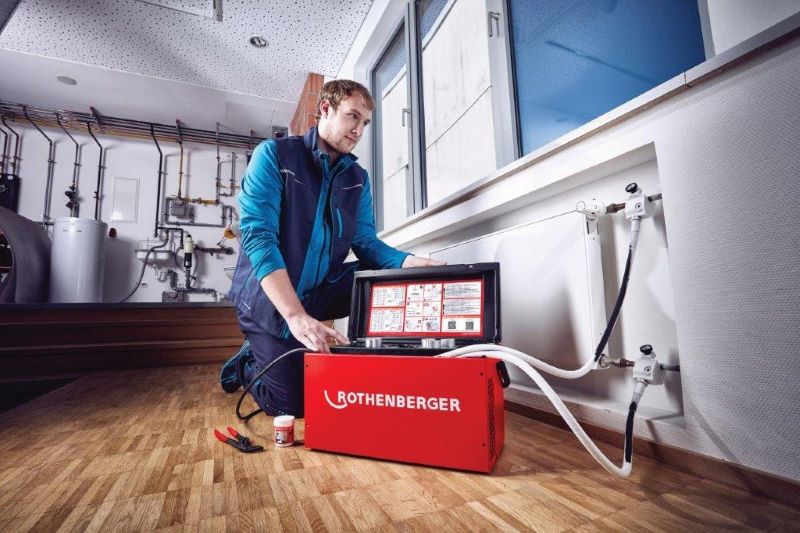
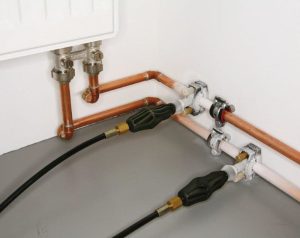
Pipe freezing in action. Supplied by Rothenberger
Pipe freezing machinery and technology are used in instances where one is not able to switch off the main water supply line for repairs. “Sometimes the plumber can’t find the line, or the main water valve is damaged,” says Adler Teubes, managing director of Rothenberger South Africa, “The other thing to consider is the application. For example, hospitals can’t have the entire building’s water supply shut off during repairs.”
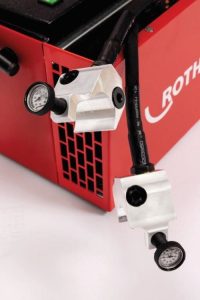
Clamps are used for the freezing process. Supplied by Rothenberger
The clamps of the pipe freezing machine are placed on one or both ends of area where you want to repair, stopping inflow of water from both directions. The machine works with refrigerant gases to freeze pipe contents. The freezing will not work on fluids that have been treated with antifreeze. Depending on ambient temperature, water temperature, and the flow rate of water in the pipe, it can take between 5 and 20 min or even much longer (hours) to freeze a pipe, depending on pipe diameter and material to freeze a pipe. Work can be done on the area and once the clamps are disconnected, the water that was frozen begins to melt.
Plumbers are advised to take special care of any freezing machinery they may have. “If you are transporting the machine, you need to make sure it’s in an upright and stable position,” advises Wessels, “You want to protect your freezing head from any mechanical damage.”
Precautions:
|
Pipe-freezing methods
- The basic method for freeze sealing can be classified based on the type of operation or type of refrigerant used. Types of operation include:
- Manual feeding of refrigerant
- Remote manual control of the freeze seal process
- Remote automatic freeze seal method
Types of refrigerants commonly used include:
- Liquid nitrogen
- Dry ice (CO2)
- Freon
- A mixture of any of the above refrigerants with alcohol or glycol.
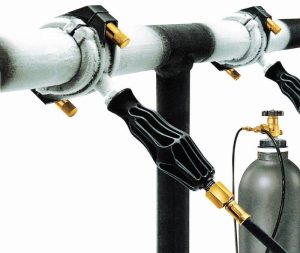
Pipe freezing can be performed on several different types of pipe. Image supplied by Machine Cutting Services
Some freeze sealing methods use mixtures of the primary refrigerants along with alcohol or glycol. In these cases, use the precautions for the most severe component of the mixture or, preferably,
precautions for all components used if they do not conflict.
“It’s best to work with rubber gloves,” says Teubes, “The clamps can get extremely cold and touching them with bare hands can result in injury like frost bite.”
Where would you use pipe-freezing
Three routine applications for freeze sealing are to:
- Enhance maintenance capabilities during shutdown or outage periods by providing pipe isolations
- Provide blocking in lines where valves or stops are not placed to replace faulty valves or to carry out pipe modifications or extensions
- Eliminate the necessity of taking a full system out of service during plant operation, which might cause a limiting condition for operation
Pipe freezing services can be used to perform any of the following routine system modifications
- Valve installations
- Pipe section replacement
- Equipment isolation
- Pipe branch terminations
- Pipe relocations
What are the benefits of using pipe-freezing
Pipe freezing is widely acknowledged as a safe, reliable and highly cost effective method of temporary pipeline isolation and offers several major benefits some of which are:
- No need to drain down systems, avoiding costly and time-consuming venting procedures
- No need to arrange for the bulk transfer/storage of fluids
- Cuts losses of expensive liquids, such as treated water and system inhibitors, as ‘break-in’ can be performed without incurring the costs and down-time of a complete system drain down
- Overcomes the problems of handling hazardous materials and enhances safety when working on lines containing contaminated or volatile liquids
- Avoids a complete system or related systems from shutting down by isolating selected sections for maintenance purposes. This is a cost cutting exercise as well as a form of on-line maintenance tool
Common pipe-freezing area applications
- Cooling water
- Fire protection systems
- Process systems
- Fuel oil lines
- Sludge lines
- Hydraulic control lines
- Domestic/utility systems
- Hydrocarbon risers
- Water injection lines
- Heat exchanger lines
- Heating services
- Chilled water systems
Common pipe contents
- Water
- Acids
- Coolants
- Paints
- Alcohols
- Oils
- Liquid food product
- Various chemicals
- Sewage
Typical pipe materials
- Carbon steel
- Nickel alloy
- Copper-based alloys
- Aluminium alloys
- Stainless steel
- Plastic
Risks of using pipe-freezing and precautions
- Nitrogen may cause asphyxiation in confined spaces
- When done without due diligence, it may result in pipe bursts and flooding
- Not applicable to moving fluids
- Relies on proper technical assessment of pipework system before embarking on pipe-freezing otherwise wrong assessments may result in pipe failures and irreparable damages
How to prepare for a pipe-freeze RFQ (Request For Quote)
When making an inquiry for pipe-freezing include the following information:
- State the fluid in the pipework
- State the temperature of the fluid to be frozen
- State the pressure of the system
- State the size of the pipe or pipe diameter
- Ensure the fluid in the pipe is stationary
- Ensure pipe is filled full bore by the fluid to be frozen
- State how many freeze-points need to be done simultaneously
- State the nearby obstacles such as very close pipes, pipe fittings such as bends, Ts, flanges, weld joints, valves and more
- Above all take appropriate and informative pictures around the area to be isolated
- If possible, take a short video around the point of freeze
- Check for accessibility for freezing equipment and communicate with the contractor to do freezing
- Approximate time to accomplish the tasks for instance time to change the valves, modify pipework.
Register for free to gain access the digital library for Plumbing Africa publications