Compiled by Tanya Olckers
In January we took a look at rainwater harvesting. What happens if you want to make that rainwater potable? Well, it’s possible. It just requires a bit more effort.

All images by Plumbing Africa
Rainwater can be harvested and used for several different applications, like garden irrigation or for topping up pool water and even for cleaning hard surfaces like paved areas. It is an excellent way to save some money on one’s municipal water bill, while also helping out the environment.
In all this, however, are we able to use the water for drinking, cleaning, washing and cooking? The simple answer is, yes, it can be used. In order to get to the stage where it can be used safely, though, there is a serious amount of filtration and purification that needs to happen first.
The thing is, you need to know where to start. Cobus Naude, General Manager (Africa) of Best Water Technology recommends beginning with testing the quality of the water collected by the storage tanks. “This will help to specify the correct system and potentially an estimate of cost,” he says.
The water quality will determine if the water can be used for household purposes and will also determine the extent of treatment that will be required to bring the water to potable use state.
A sample is taken from the collected water and sent to an independent laboratory that performs a full SANS 241 analysis. The SANS 241 requirements outline the minimum standards that are acceptable when it comes to potable water that is safe to drink. The test looks at biological particles, chemicals, the aesthetics of the water itself and any organic material that may be present in it.
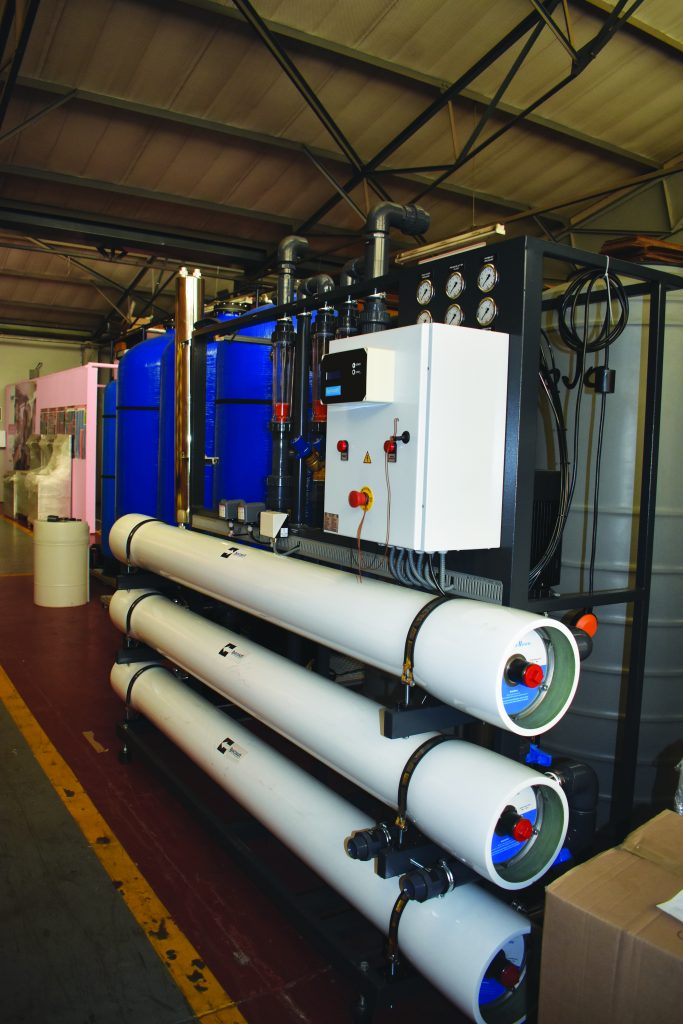
A commercial water filtration unit.
Not all the water collected is fit for drinking or household use. The water quality test, in line with SANS 241 guidelines, is something that should be done on a regular basis if the water is being utilised for consumption. While the guidelines don’t provide a specified schedule regarding how often tests should be done, your professional installer may provide some insight.
“Water testing with filtration needs to be regular and ongoing,” advises Steve van Zyl, Technical Manager at IOPSA. “Tanks also need to be serviced regularly.”
| What does SANS 241 say about water testing?
According to SANS 241 – Drinking Water Part 2, paragraph 4.2.3, testing needs to be done on raw water (prior to filtration) and water after treatment (final water). This stipulation indicates water treatment plants, however, testing in these areas in a domestic or commercial filtration and purification system is advisable. SANS 241 paragraph 4.2.4 stipulates that assessment needs to be conducted when the poorest water quality is anticipated or during peak demand times, and recommends that the tests be done annually. SANS 241 provides an extensive framework for drinking water safety. |

Industrial filtration system.
Filtration and purification
To recap, water filtration begins as the rain comes off a roof surface with a ‘leaf catcher’, then an initial filtration that is expelled as the first flush, after which the water passes into the storage tank.
The system will include a first water storage tank that feeds into a treatment tank. This is where filtration and purification will take place. The water is then moved to a holding tank to then be pumped into the home for household use.
Within the treatment tank, the water will go through a liquid chlorine dosing system. This chlorine is administered via a floater, and while it looks a lot like the floater you would put into a pool, its contents are a little different as it does not contain the harmful chloride. This chlorine floater is specifically designed so that the chlorine dose administered to the tank is not harmful to humans.
The water then moves through a section composed of three filters called the triple big blue system. This first section of filters ensure that larger particles and sediments are removed, so that the water is usable for irrigation. This is usually a 20-micron filter. The water then passes through a carbon filter which clears up the taste, removing chlorine. The carbon in the filter acts like a sponge, soaking up all additional organics and particles.
From there, the water moves into a third, 1-micron filter, which removes even more particles.
Here, filtration methods diverge.
UV Light and Ozonation
In one method, UV light is used to sterilise the water. The UV light acts as a steriliser on the water, killing bacteria and parasites. This method needs a steady supply of electricity in order to keep it running, and the UV light bulbs, which are essential to this form of treatment, will need to be replaced from time to time.
In the holding tank, ozonation can take place as part of the process.
| Ozonated water is made through the use of an ozone generator. This causes a reaction seeing an oxygen molecule being split into two oxygen atoms. These atoms go on to form ozone. This ozonated water helps to dissolve any nasties like bacteria and other micro-organisms lurking in the water. It is odourless and tasteless. |
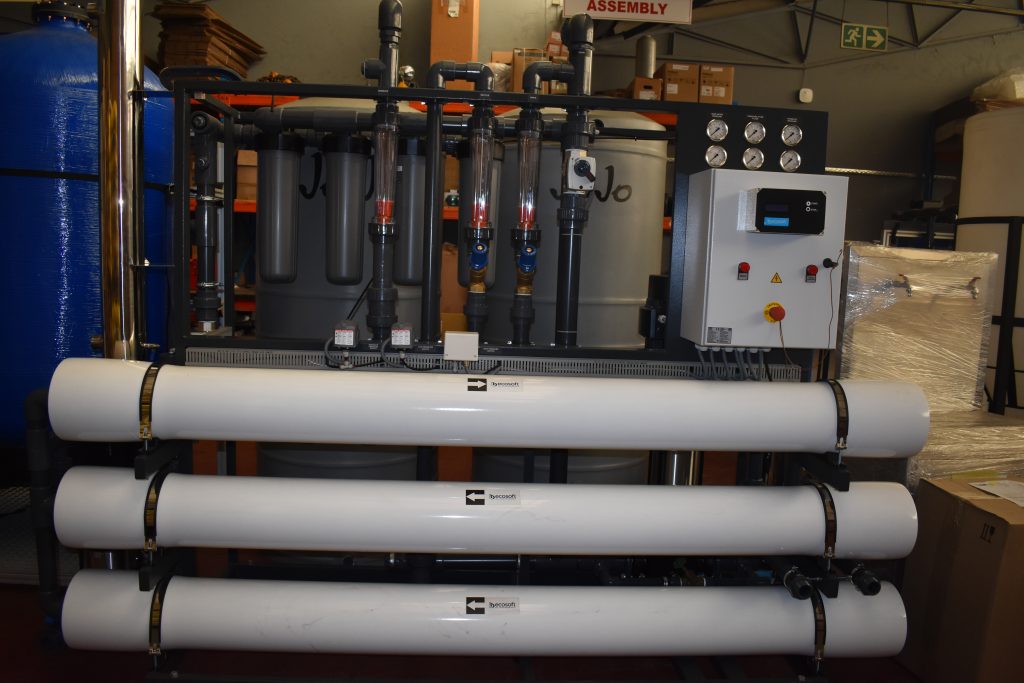
Water filtration unit
Reverse Osmosis
Within the holding tank, the water can be treated with reverse osmosis to ensure that it is of a greater quality and is potable. Reverse osmosis strips away minerals found within the water. This results in a lower pH.
If there are copper pipes present in the home or on the tanks, it’s best to err on the side of caution as copper can potentially leach into the water. Water that’s had its minerals extracted through a reverse osmosis process has a low pH, and this in turn causes the water to be corrosive, leading to metals leaching into water.
This can be mitigated through using a remineralised column. Minerals are returned to the water after the reverse osmosis process so that the pH increases.
Liquid chlorine is an oxidant, while ozone is an antioxidant. At the end of these processes, it’s worth considering remineralisation.
What it boils down to is what degree to you want to use this water for? The system then needs to be designed according to the raw water quality. Installers are happy to work with plumbers when it comes to installation, with many offering operating and instruction manuals. This filter system can be replicated on a larger scale for commercial and industrial use.
Another important thing to keep in mind is that tanks will need to be regularly sanitised. One of the factors to consider here is the size of the tank.
Remember that filtration must consider the acidity of the water and the removal of all organics. A backwashable filter could be the answer. The filter media in this kind of filter is back washed preventing bacterial growth. This process can be automatic and set to a timer. Sand filtration can also be used. A backwashable carbon filter can provide extended contact time with the water, potentially filtering even greater amounts of organic material and can also extend the life of the carbon filter. Carbon is like a sponge, and it absorbs water and microscopic matter continuously.
[SANS 10252-1: WATER SUPPLY AND DRAINAGE.]
Uses for filtered rainwater
Harvested water is best used for gardening and cleaning hard surfaces like paving and flushing toilets. This water must not be connected with your municipal water as this can cause a significant health risk. Where rainwater harvesting and recycling can do a lot of good is during times of food shortage, and it can be a huge help to impoverished communities.
A few words about tanks
“The quality of the water depends on the source of the water,” says Sebasti Badenhorst from JoJo Tanks. “Harvested rainwater needs prefiltration to remove dust, leaves and larger debris. Contaminants, such as e-coli and coliforms can enter the tank when bird droppings collected on the roof washes into the tank during a rainstorm.
Apart from pre-filtration, it is therefore critical that rainwater should be filtered with a filtration system capable of removing these contaminants if it is used for consumption. It is generally not necessary to clean your tanks regularly provided you have prefiltration system. A properly seized first flush system can save you the effort, and it will also provide cleaner water to your filtration system when water is used for consumption.”
If you are planning to install rainwater harvesting systems, the more storage capacity you have the better. Large amounts of water can be collected in heavy rainstorms. It is therefore necessary to have a clip-on lid on the tank, which can act as an emergency overflow.
The best course of action is to work responsibly, have a deep and comprehensive understanding of all the elements that make up rainwater harvesting and purification. Make sure you are familiar with local by-laws. Plan before you begin your work and get the right kind of training to know exactly what you are doing. Above all, ensure that when it comes to filtration, water testing is regular and ongoing to ensure safety.
Register for free to gain access the digital library for Plumbing Africa publications