By Patrick Gordon, Technical Manager, Splashworks
Before we discuss when you would use a thermostatic mixer, let us discuss why you would use one.

The workings of a thermostatic mixer are to deliver a constant blended temperature at a terminal point.
SANS 10252-1:2018 says:
6.6.1.7 If the heating medium cannot safely control the maximum temperature in a water heater to 60°C, a tempering valve shall be installed near the water heater in accordance with the manufacturer’s instructions and should the maximum temperature need to be thermostatically controlled at terminal fittings (i.e. for frail care, people with disabilities and infants) thermostatic mixers shall be installed.
From this extract it is clear that the law requires us to control the temperature at all terminal points and that a tempering valve should be used to do so. But the extract also speaks about a thermostatic mixer. What is the difference between a tempering valve and a thermostatic mixer?
A tempering valve will deliver a constant downstream temperature, but if the cold/hot water supply fails there will still be water flow and a user can still be scalded. A thermostatic mixer has a failsafe feature built in that will completely disable all water flow should the hot- or cold-water supply fail. This, then, would give the user total protection against scalding.
SANS also regulates the minimum temperature that is allowed at different types of terminal points.

Supplied by Advanced Valves
7.5.1.4.1 Minimum supply temperature
Unless otherwise required, the temperature of hot water available
- at domestic fixtures such as baths, basins and showers shall be at least 38°C, and
- at sinks, shall be at least 45°C (in order to melt fats).
These regulations are for health reasons. One of these is to protect us against the bacteria called Legionella Pneumophila. This bacterium gives us flu-like symptoms, and if not treated properly, will be fatal. One of the best ways to destroy the bacteria is with temperature control. Below 20°C, the bacteria become dormant and do not multiply. In temperatures above 60°C, the bacteria are killed. This is why the recommended storage temperature is 60–65°C – so that all possible Legionella bacterium is destroyed.
By keeping the temperatures high we make sure that Legionella is not present in our plumbing system, however it does create another threat, namely scalding. Most of us can react quick enough to prevent scalding, however we have children, older persons and frail persons that use the same systems as us and they do not have the same reaction time as we have.
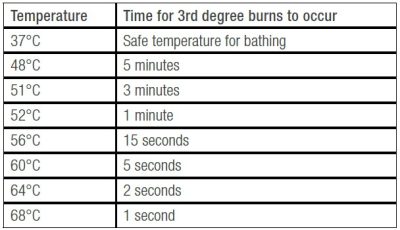
This chart below gives an indication of contact time at different temperatures for third-degree burns to occur.
The only way to protect ourselves from both threats is by installing a thermostatic mixer as close as possible to the terminal draw off point. This will expose most of the plumbing installation to the higher temperature but also protect the users from scalding.
We have only concentrated here on the hot water line, but we also have to ensure that the cold-water line temperature does not rise above the 20°C mark. This will ensure that Legionella is kept dormant in these lines also.
| Need help or advice?
For any further information regarding this topic please contact: Patrick Gordon | 083 303 1437 | patrickg@splashworks.co.za Do you have a technical question for Patrick? Email your technical questions to megan@interactmedia.co.za, with the subject line ‘technical question’. |